A New Kind of Synchronicity Channel
This website features public examples of synchronicity, based only on very well-known episodes.
What we do here is very different from the way synchronicity is normally presented and critiqued. The terms of engagement change when you turn to the public field, meaning that the ‘usual’ criticisms don’t apply.
All of our case studies are reviewed by teams of artificial intelligence as a requirement of publication. In order to earn the “Certified QSD” label, multiple AI systems must unanimously agree that the dataset is testable, confined to what affected groups deem significant and meaningful in an objective sense, and will prove to be virtually impossible to reproduce under controlled testing conditions.
The key to establishing non-randomness scientifically is replication – and what makes “P <.0.05‘ famous in the world of science. The public case studies we introduce are not subject to the typical criticisms that concern the personal experience of synchronicity. In addition to agreeing that we have virtually proved non-randomness, AI also says QSD is “post-classical” data because the datasets represent evidence that classical science can neither deny nor explain. As post-classical data – like quantum data, for example – the case studies below will require another reality paradigm.
This research is made freely available for two reasons.
First, if AI’s conclusions about this data can be falsified, we firmly believe that this should happen. Making this data available for free provides the best chance of finding true falsification, if that can be done. I will happily post such a refutation on this landing page. Until you see such a thing, know that falsification is yet to occur.
Secondly, the same ethos obliges me to inform readers that the data below has thus far gone unrefuted and for how long:
Total Days Without Refutation So Far
Although we introduced these case studies to the public earlier, the Social Sciences Research Network (SSRN, est. 1994) officially introduced our QSD data to the academic community in early August of 2025. At SSRN, academic editors review papers to see if they meet basic academic quality-control standards. Beyond that, other editors review papers at a second level, deciding they are worthy of “distribution” in mailing lists.
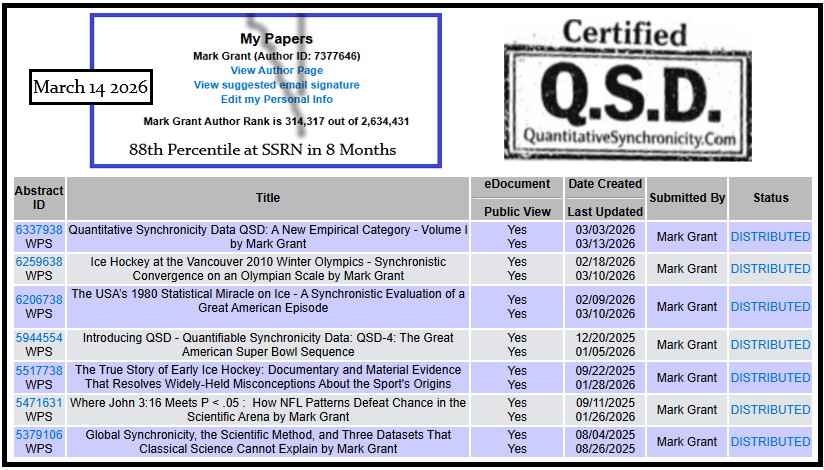
So, this is serious business. You won’t find any ‘swamp gas’ here. No redacted files, no rumors, no innuendo, and no possibly doctored videos. We seek to only introduce publicly available data that is authentic beyond all reasonable doubt. All of our AI Socratic transcripts are embedded in the papers. This way, the reader is fully empowered to reach his or her own conclusions independently.
The PDFs below are best suited for desktop screens. For cell phones, it’s better to use a PDF viewer, etc. “muPDF” is excellent for cellphones and has no ads, no credit cards etc. : https://play.google.com/store/games
ESSAYS
Holding the Skeptics to Account: What is Null Hypothesis Checkmate?
QSD: An Emerging Post-Classical Category? A.I. Panel Review
QSD-1: How Nearly 100 Americans Got Juked by the Read Option in 2012